
Blogger Outreach Strategies: That Actually Build Authority
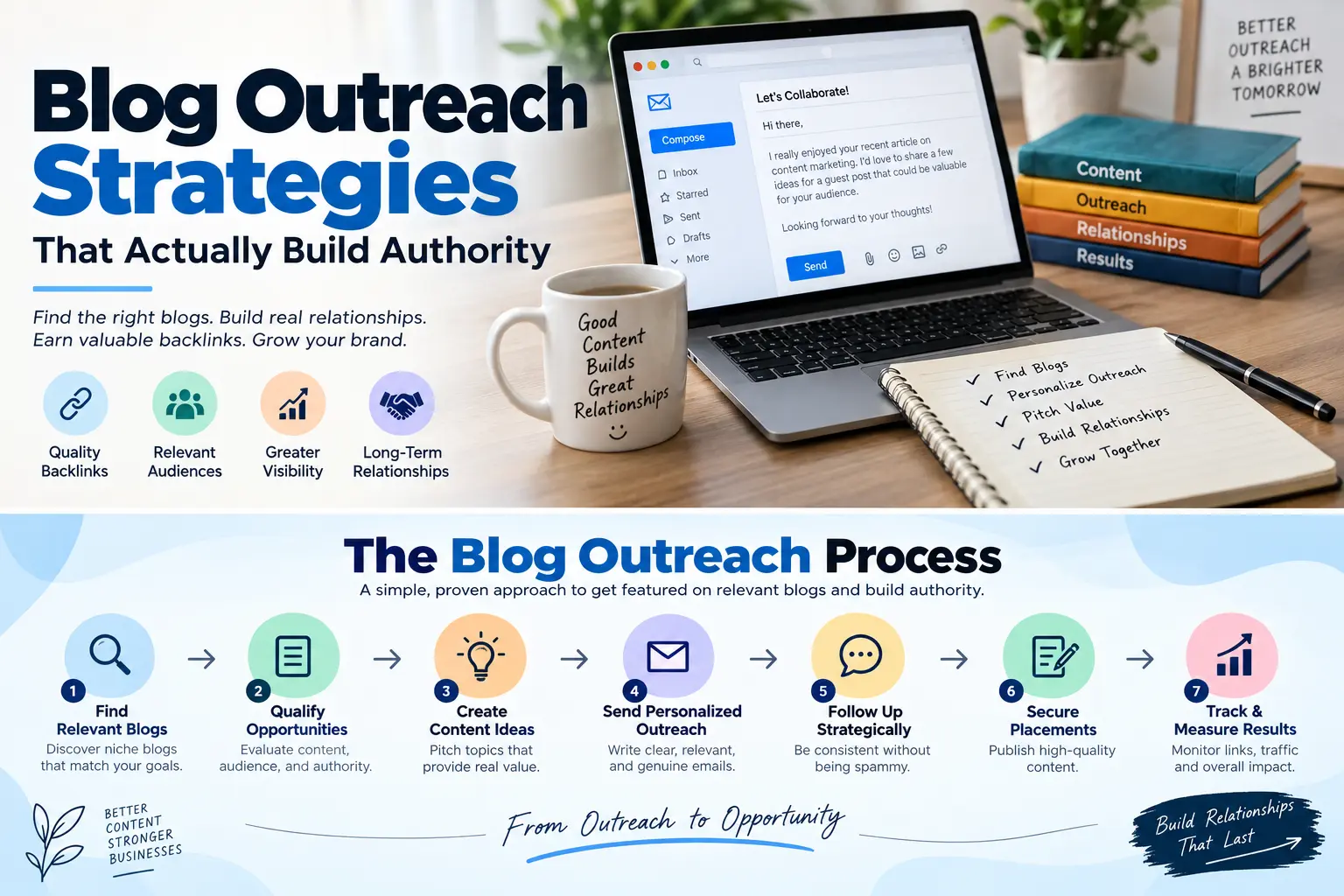
Blogger outreach can be an effective way to get your content in front of relevant audiences, build relationships with publishers, and earn valuable editorial mentions and backlinks. But successful outreach is not about sending hundreds of emails and hoping someone replies.
The difference usually comes down to who you contact, what you offer, how relevant your pitch is, and whether your content genuinely deserves to be published.
A strong blog outreach strategy starts with research. Instead of building a huge list of websites, you identify publications that are relevant to your industry, understand what their readers want, and create a reason for the publisher to work with you.
This guide breaks down practical blogger outreach strategies you can use to find suitable websites, create better pitches, follow up without becoming spammy, and measure whether your outreach is actually working.
What Is Blog Outreach?
Blog outreach is the process of contacting bloggers, publishers, editors, and website owners to propose a mutually useful content opportunity.
Depending on the campaign, that opportunity could involve:
- Contributing a guest article
- Earning an editorial mention
- Promoting original research or data
- Collaborating on expert content
- Updating an existing resource
- Building a long-term content relationship
For SEO campaigns, blog outreach and link building outreach are often used to identify relevant publishing opportunities where a backlink may be included naturally within useful content.
The important distinction is that the goal should not simply be to obtain a link. The website, article, audience, and link should all make sense together.
What Makes a Blog Outreach Strategy Successful?
A good outreach campaign is built around three things:
Relevance
The website should be related to your industry, topic, audience, or a closely connected subject.
A backlink from a website that has nothing to do with your business may look impressive in a spreadsheet, but it does not necessarily provide meaningful value.
Value
Publishers have a reason to reject your email. Your pitch needs to give them a reason to consider it.
That could be a genuinely useful article idea, original research, expert insight, or content that fills a gap on their website.
Relationships
The best outreach campaigns are not one-time transactions.
If an editor knows that you consistently provide useful, well-written content and respect their guidelines, future collaborations become easier.
This is where effective blogger outreach strategies differ from mass email campaigns.
Turn Your Blog Outreach Strategy Into Results
If you want to spend less time managing outreach and more time growing your business, our team can help you build and manage a targeted blogger outreach campaign focused on relevant websites and quality publishing opportunities.
Ready to strengthen your outreach strategy? Get Started With Our Outreach Service
10 Effective Blog Outreach Strategies
1. Define Your Outreach Goal Before Finding Websites
Don’t start by collecting hundreds of websites.
First decide what you actually want from the campaign.
Your objective could be:
- Earn relevant backlinks
- Increase brand visibility
- Generate referral traffic
- Promote original research
- Secure guest post opportunities
- Build relationships with industry publishers
- Reach a specific audience
Your goal determines which websites you should target and how you should approach them.
For example, a website that has a highly relevant audience but modest traffic may be more useful for referral traffic than a large general-interest website with little connection to your industry.
2. Find Blogs That Are Relevant to Your Niche
Prospecting is one of the most important parts of blog outreach.
Look for websites that regularly publish content related to your topic rather than relying only on large lists of “guest post sites.”
Useful prospecting methods include:
- Google search operators
- Competitor backlink analysis
- Industry directories
- Manual Google research
- SEO platforms
- Existing publisher relationships
- Niche communities and publications
Search operators can help uncover potential opportunities. For example:
your topic + "write for us"your topic + "guest post"your topic + "contribute"your topic + "become a contributor"
However, don’t assume that a website is valuable simply because it has a “Write for Us” page.
Some sites actively accept contributors but publish low-quality or unrelated content. Always evaluate the website itself.
For a detailed prospecting process, see how to find blogs for guest post outreach.
3. Qualify Every Website Before You Reach Out
This is where many outreach campaigns go wrong.
A large prospect list means very little if most of the websites are poor matches.
Before adding a website to your campaign, consider:
- Is the website relevant to your niche?
- Does it publish original content?
- Is the content written for real readers?
- Does the website appear to have an active audience?
- Does it regularly publish new articles?
- Are its editorial standards clear?
- Does it link to useful external resources naturally?
- Is the site overloaded with sponsored or guest content?
- Would your target audience actually benefit from reading it?
SEO metrics such as Domain Rating, Domain Authority, estimated organic traffic, and referring domains can help with initial screening.
But don’t make the mistake of treating a third-party metric as a complete quality assessment.
Metrics are signals, not guarantees.
A smaller, highly relevant publication can sometimes be a better outreach opportunity than a larger site with weak topical relevance.
4. Study the Website Before Writing Your Pitch
Generic outreach is easy to recognize.
If your email could have been sent to 500 websites without changing a single sentence, it probably isn’t personalized enough.
Before contacting a publisher, spend a few minutes understanding the website.
Look at:
- Recently published articles
- Popular content topics
- Content gaps
- Editorial style
- Target audience
- Existing guest contributions
- Topics they rarely cover but are relevant to their readers
Then use that research in your pitch.
Instead of saying:
“I would like to contribute a high-quality article to your website.”
Explain why your proposed topic fits their audience.
The difference is small in wording but significant in strategy.
5. Pitch Content Ideas, Not Just Backlinks
A publisher is interested in content that helps their readers.
That means your pitch should lead with the article idea, not your desired anchor text or target URL.
Strong content ideas generally:
- Address a genuine reader problem
- Add something different to existing coverage
- Have a clear search or audience intent
- Fit the publication’s editorial style
- Can be supported with useful examples or evidence
For example, instead of pitching a vague topic such as:
“10 Benefits of Digital Marketing”
you could develop a more specific angle such as:
“How Small Businesses Can Build a Sustainable Content Promotion Strategy”
The second idea gives the publisher a clearer reason to consider the article.
6. Personalize Your Outreach Emails
Personalization does not mean inserting someone’s first name into a template.
Real personalization shows that you understand the publication.
A useful outreach email can include:
- A relevant opening
- A specific reference to the website
- One or two suitable content ideas
- A short explanation of the value
- A simple call to action
Keep the email concise.
Editors are busy. A five-paragraph sales pitch is unlikely to outperform a clear message that gets to the point quickly.
You can also use blogger outreach email templates as a starting point, but templates should be customized rather than copied and sent at scale.
7. Follow Up Without Becoming Spammy
No response does not automatically mean rejection.
Editors may miss an email, postpone the decision, or simply be busy.
A reasonable follow-up process can include:
- First follow-up after several days
- Second follow-up roughly a week later
- Final message that closes the conversation politely
Each follow-up should be short.
Don’t send the same message repeatedly or continue contacting someone indefinitely.
Good outreach is persistent without becoming intrusive.
8. Create Content That Deserves the Placement
Getting a publisher to say yes is only half the job.
The content itself has to meet their standards.
Strong outreach content should:
- Be original
- Match the publication’s audience
- Provide practical information
- Use credible sources where appropriate
- Avoid unnecessary promotion
- Follow the publisher’s formatting requirements
- Add something beyond what already exists online
If the article is obviously written only to place a backlink, the publisher has little incentive to publish it.
A useful rule is simple:
Would this article still be worth publishing if the backlink did not exist?
If the answer is no, improve the content idea.
9. Use Natural, Contextually Relevant Links
Link placement should make sense for the reader.
Avoid forcing an exact-match commercial keyword into every article simply because it is your target keyword.
Natural links can point readers toward:
- Detailed guides
- Original research
- Useful tools
- Supporting resources
- Relevant service pages
- Case studies
The surrounding content should explain why the resource is useful.
This creates a better experience for readers and produces a more natural editorial placement.
10. Measure What Actually Matters
Sending 1,000 emails does not automatically mean you ran a successful campaign.
Track the full outreach funnel.
Important metrics include:
| Metric | What It Tells You |
|---|---|
| Prospects contacted | Campaign reach |
| Response rate | Whether your targeting and pitch generate interest |
| Positive response rate | Quality of your opportunities |
| Placement rate | How effectively responses turn into publications |
| Backlinks earned | Link acquisition |
| Referral traffic | Audience value of placements |
| Conversion rate | Business impact |
| Cost per placement | Campaign efficiency |
Look at the numbers together.
For example, a low response rate may indicate poor targeting or weak personalization. A strong response rate but low placement rate could mean your content ideas, pricing, or editorial fit need improvement.
That is much more useful than simply celebrating the number of emails sent.
A Practical Blog Outreach Process
A repeatable campaign can follow this workflow:
Step 1: Set the campaign objective
Determine whether you’re primarily targeting links, traffic, visibility, relationships, or a combination.
Step 2: Build your prospect list
Find websites that are genuinely relevant to your industry and audience.
Step 3: Qualify prospects
Review relevance, content quality, audience signals, editorial standards, and SEO data.
Step 4: Research each publisher
Understand what they publish and what their readers care about.
Step 5: Develop content ideas
Create topics that fit the publication rather than simply promoting your own service.
Step 6: Personalize the pitch
Explain why your idea is relevant to that particular website.
Step 7: Follow up
Use a limited and professional follow-up sequence.
Step 8: Produce the content
Meet the publisher’s requirements and prioritize reader value.
Step 9: Review the placement
Check the published article, links, attribution, formatting, and overall quality.
Step 10: Measure results
Track placements, links, traffic, conversions, and campaign efficiency.
This process turns blog outreach from random email activity into a repeatable marketing system.
Example: What a Targeted Blog Outreach Campaign Looks Like
Imagine a SaaS company that sells project management software.
Instead of contacting every website that accepts guest posts, the marketing team could target publications covering:
- Project management
- Productivity
- Remote work
- Startups
- Business operations
- Team collaboration
They could then review each website and identify content gaps.
For one productivity publication, they might pitch an article about improving project workflows for distributed teams.
For a startup publication, they could propose an article about building efficient project management processes as a company grows.
The underlying company is the same, but the pitch changes according to the audience.
That is the key principle behind effective outreach.
The numbers in any campaign will vary, so avoid treating a fixed response or placement rate as a guaranteed benchmark. Your results depend on niche, prospect quality, offer, content, sender reputation, and publisher standards.
Tools That Can Help With Blog Outreach
Manual research can work well for smaller campaigns, but tools can make larger campaigns easier to manage.
BuzzStream
Useful for organizing prospects, contacts, outreach conversations, and relationship history.
Pitchbox
Designed for prospect discovery and outreach campaign management.
Respona
Combines prospect research with outreach workflow features.
Hunter
Can help identify professional email addresses associated with domains.
Ahrefs and Semrush
Useful for competitor backlink research, website analysis, and identifying potential publishing opportunities.
The tool itself is not the strategy.
A poorly targeted campaign run through sophisticated software is still a poorly targeted campaign.
Benefits of a Strong Blog Outreach Strategy
A well-executed campaign can support several marketing objectives.
Relevant Backlink Opportunities
Publishing on relevant websites can create opportunities for editorially appropriate backlinks and mentions.
The value depends on the quality and relevance of the publication rather than simply the number of links acquired.
Referral Traffic
A placement can introduce your business to readers who are already interested in your subject area.
In some cases, that audience value can be more meaningful than the SEO value of the backlink itself.
Brand Visibility
Being mentioned or featured on respected industry websites can put your brand in front of potential customers who may not discover it through search alone.
Publisher Relationships
Consistent, professional communication can lead to future collaborations, additional content opportunities, and stronger industry relationships.
Content Distribution
Outreach can also be used to promote original research, reports, expert commentary, and other assets that deserve a wider audience.
Common Blog Outreach Mistakes to Avoid
Even a well-planned campaign can underperform when the fundamentals are ignored.
Sending the same email to everyone
Mass templates make personalization almost impossible.
Choosing websites based only on SEO metrics
A high DR or DA does not automatically mean a website is relevant or valuable.
Targeting unrelated websites
Relevance should be one of the first filters in your prospecting process.
Pitching weak topics
If the topic does not provide value to the publication’s readers, personalization will not save the pitch.
Making the email too promotional
The publisher is interested in useful content, not a sales brochure.
Ignoring editorial guidelines
If a website clearly explains its contributor requirements, read them before pitching.
Using unnatural anchor text
Links should fit naturally within the content instead of being forced around commercial keywords.
Following up endlessly
Persistence is useful. Repeated unwanted emails are not.
Measuring only backlinks
A campaign can generate links but fail to generate meaningful traffic, visibility, or business value. Look at the wider picture.
Blog Outreach vs. Blogger Outreach vs. Guest Post Outreach
These terms are closely related, but they are not always interchangeable.
| Approach | Primary Focus |
|---|---|
| Blog outreach | Connecting with relevant blogs and publishers |
| Blogger outreach | Building relationships with bloggers and content creators |
| Guest post outreach | Finding opportunities to contribute articles |
| Link building outreach | Identifying opportunities to earn relevant links and mentions |
| Digital PR outreach | Connecting with journalists, publications, and media outlets |
In practice, one campaign may use several of these approaches.
The important thing is to define the objective before choosing the outreach method.
Frequently Asked Questions About Blog Outreach Strategies
What is the most effective blog outreach strategy?
There is no single strategy that works for every niche. In most campaigns, the strongest foundation is targeted prospecting, genuine personalization, useful content ideas, professional follow-ups, and careful measurement.
How do I find blogs for outreach?
You can find prospects through Google search operators, competitor backlink research, industry publications, SEO tools, directories, and manual research. Always qualify websites before contacting them.
Is blog outreach good for SEO?
It can support SEO when it results in relevant, editorially appropriate mentions or backlinks. However, outreach should not be treated as a guaranteed ranking shortcut. Website relevance, content quality, link context, and overall SEO strategy all matter.
How many outreach emails should I send?
There is no universal number. Start with a manageable group of highly relevant prospects, evaluate the response and placement rates, and expand once you know what works.
How often should I follow up?
A small number of well-spaced follow-ups is generally more sensible than repeatedly emailing the same publisher. The exact timing can vary by campaign and publisher.
Should I prioritize Domain Authority or Domain Rating?
Neither should be your only deciding factor. These are third-party metrics that can help with prospect screening, but topical relevance, content quality, audience fit, organic visibility, and editorial standards should also influence your decision.
What makes a blogger outreach email effective?
A strong email is relevant, concise, personalized, and focused on the publisher’s audience. It should give the recipient a clear reason to continue the conversation without forcing a sales pitch.
Is guest posting the same as blog outreach?
No. Guest posting is one possible outcome of blog outreach. Blog outreach is the broader process of identifying and contacting publishers to develop content or promotional opportunities.
Final Thoughts: Build Relationships, Not Just Backlinks
The best blog outreach strategies are not built around sending the highest number of emails.
They are built around finding the right publications, understanding their audiences, proposing genuinely useful content, and developing relationships with publishers over time.
If your campaign focuses only on acquiring backlinks, it is easy to lose sight of the bigger opportunity: reaching relevant audiences, building brand credibility, earning editorial mentions, and creating content partnerships that can continue producing value.
For businesses that don’t have the time or internal resources to manage prospecting, personalization, follow-ups, and publisher relationships, professional blogger outreach services can provide a more structured way to manage the process.
The goal should not be more outreach.
It should be better outreach to the right websites.